Understanding Dog Reactivity: Beyond Bad Behavior
Dog Reactivity, Behavior Understanding, Pet Owner Advice
Understanding Dog Reactivity: It’s Not About Being “Naughty”
As a senior software engineer who also lives with a wonderfully complicated, reactive dog, I’ve learned that debugging canine behavior isn’t so different from debugging production code. What looks like “bad behavior” is usually just a visible symptom of deeper emotional responses and unmet needs. In this post, we’ll walk through what dog reactivity really is, why it is not the same as disobedience or “canine aggression,” and practical, engineering-style strategies and dog training tips you can apply as a pet owner.
1. What Reactivity Really Is (and Isn’t)
In human terms, dog reactivity is an over-sized emotional response to a trigger in the environment: another dog, a skateboard, a stranger, even a doorbell. It often looks like barking, lunging, growling, or spinning at the end of the leash. To outsiders, it can resemble canine aggression, but that’s an oversimplification. Reactivity is more about emotion than intention to harm.
If you think in software terms, reactivity is like a system that’s extremely sensitive to certain inputs. The input (a passing dog) is small, but the output (explosive barking) is huge because the internal state is already close to its limit. The dog is not “naughty”; the system is simply misconfigured and under too much load.
📌 Key Takeaway: Reactivity is an emotional overflow, not a moral failure or a dominance issue.
2. Behavior Understanding: Looking Under the Hood
When we debug a flaky service, we don’t just stare at the error message; we inspect logs, metrics, and context. Behavior understanding for a reactive dog works the same way. Instead of only looking at the surface behavior (barking, lunging), we ask:
What triggered this reaction? (Another dog, a noise, a sudden movement?)
What was my dog’s body language before the explosion? (Stiff, lip licking, yawning, turning away?)
How close were we to the trigger? (Distance is often the most important variable.)
What is my dog’s history with this kind of trigger? (Past trauma, lack of socialization, pain?)
Over time, you build a mental “monitoring dashboard” for your dog’s emotional state. That’s the core of behavior understanding: mapping inputs, internal state, and outputs so you can change the system safely and kindly.
💡 Pro Tip: Keep a small training journal. Log date, trigger, distance, and your dog’s reaction. Patterns will appear faster than you expect.
3. Emotional Responses: Fear, Frustration, and Over-Arousal
Underneath most reactivity are powerful emotional responses. The three big ones are:
Fear-based reactivity: “I’m scared, so I’ll make the scary thing go away.” The dog barks and lunges to increase distance from the trigger. When the trigger leaves, the dog feels that the behavior “worked.”
Frustration-based reactivity: “I want to get to that thing and I can’t.” Common in social, energetic dogs who feel restrained by the leash and explode out of frustration when they can’t greet.
Over-arousal: The dog is simply too excited or stressed overall. Think of it as a CPU pegged at 100%: even a small input causes a big spike in output.
Understanding which emotional response is driving your dog’s reactivity shapes your reactive dog solutions. You can’t treat fear the same way you treat frustration, just like you wouldn’t handle a memory leak the same way you handle a network timeout.
4. Reactivity vs. Canine Aggression: Important Distinctions
Canine aggression is a serious topic, and sometimes reactivity and aggression do overlap. However, they are not synonyms. A reactive dog may never actually intend to bite; they want the scary or exciting thing to move away or come closer, not necessarily to harm it. Aggression, on the other hand, is a pattern of behavior where the dog is willing to follow through with a bite, often with less warning and more intensity.
From a pet owner advice perspective, the distinction matters because it changes your risk assessment and your training plan. Many leash-reactive dogs can live full, safe lives with management and training, even if they look terrifying on walks. Still, if your dog has a history of biting or you feel unsafe, it’s time to bring in a qualified behavior professional, just like you’d escalate a severity-one incident to the right expert instead of trying random fixes in production.
⚠️ Warning: If your dog has bitten or snapped at people or dogs, consult a certified behavior professional and your vet. Safety and proper assessment come first.
5. Thinking Like an Engineer: Modeling Reactivity as State and Triggers
As developers, we’re used to modeling complex systems as state machines. You can apply a similar mental model to your dog’s reactivity. Imagine your dog’s emotional state as a variable that moves between “calm,” “alert,” “stressed,” and “over threshold.” Triggers and context shift that state up or down. Training then becomes the process of changing how those transitions work and adding safety checks.
Here’s a playful Python-style sketch to illustrate how behavior understanding might look in code. This is not for real-world automation, but it can help you reason about your dog’s emotional responses:
from enum import Enum, auto


class EmotionalState(Enum):
    CALM = auto()
    ALERT = auto()
    STRESSED = auto()
    OVER_THRESHOLD = auto()


class DogContext:
    def __init__(self):
        self.state = EmotionalState.CALM
        self.distance_to_trigger = None  # meters
        self.sleep_hours = 8
        self.physical_exercise = "moderate"  # low, moderate, high

    def update_state(self, trigger_type: str, distance: float) -> None:
        self.distance_to_trigger = distance

        if trigger_type == "dog" and distance < 3:
            if self.state in {EmotionalState.CALM, EmotionalState.ALERT}:
                self.state = EmotionalState.STRESSED
            else:
                self.state = EmotionalState.OVER_THRESHOLD

        elif trigger_type == "skateboard" and distance < 5:
            self.state = EmotionalState.STRESSED

        # Global modifiers
        if self.sleep_hours < 6:
            # tired dogs have less emotional buffer
            if self.state == EmotionalState.STRESSED:
                self.state = EmotionalState.OVER_THRESHOLD

    def can_learn(self) -> bool:
        return self.state in {EmotionalState.CALM, EmotionalState.ALERT}
In real life, when your dog is in an OVER_THRESHOLD state (barking and lunging), they can’t learn well. That’s why one of the most important dog training tips for reactivity is: train under threshold. Work at a distance and in conditions where your dog can notice the trigger but still think, take food, and respond to you.
6. Core Dog Training Tips for Reactive Dogs
Tip 1: Management Is Not Failure
In engineering, we often put in circuit breakers, rate limiters, and feature flags to protect our systems. For a reactive dog, management tools play a similar role: they reduce the number and intensity of triggers while you work on long-term change. Management might include:
Walking at quieter times or on quieter routes
Using window film or barriers at home to reduce visual triggers
Using secure equipment (well-fitted harness, double leash, muzzle if needed)
Management doesn’t “fix” reactivity, but it prevents repeated explosions that can reinforce unwanted behavior and keep your dog’s stress baseline too high. It’s a key part of effective reactive dog solutions.
Tip 2: Classical Conditioning – Changing the Emotional Response
One of the most powerful dog training tips for reactivity is to pair the trigger with something your dog loves, usually high-value food. This is classical conditioning: “Dog appears → chicken rains from the sky.” Over time, the dog’s emotional response shifts from “Oh no!” to “Oh, that predicts good things.”
In code-style pseudologic, your training loop might look like this:
def training_session(dog_context: DogContext, trigger_seen: bool) -> None:
    if trigger_seen:
        if dog_context.can_learn():
            # mark the trigger ("Yes!") and deliver food
            print("Marker: Yes!")
            print("Deliver: high-value treat")
        else:
            # dog is over threshold, increase distance and exit session
            print("Too close - increase distance and end on a calm note")
    else:
        # no trigger, just reinforce calm behavior
        print("Reinforce: walking calmly, checking in, loose leash")
The real-world version is simple: when your dog notices the trigger at a safe distance, mark it with a word like “Yes” or a clicker, then feed several small treats. If your dog can’t take food, you’re too close; increase distance and try again later.
Tip 3: Teach Alternative Behaviors
Once your dog can stay under threshold around triggers, teach them specific skills that are incompatible with reacting: looking at you, turning away, or moving behind you. These become your “API calls” for real-life situations.
“Look at me”: Dog makes eye contact with you instead of staring at the trigger.
“Let’s go” / U-turn: Dog turns and walks away with you when you cue it.
“Behind”: Dog moves behind your legs, using you as a safe shield.
Practice these first in low-distraction environments, then gradually add mild triggers at a distance. Think of it as unit testing before integration testing in the wild.
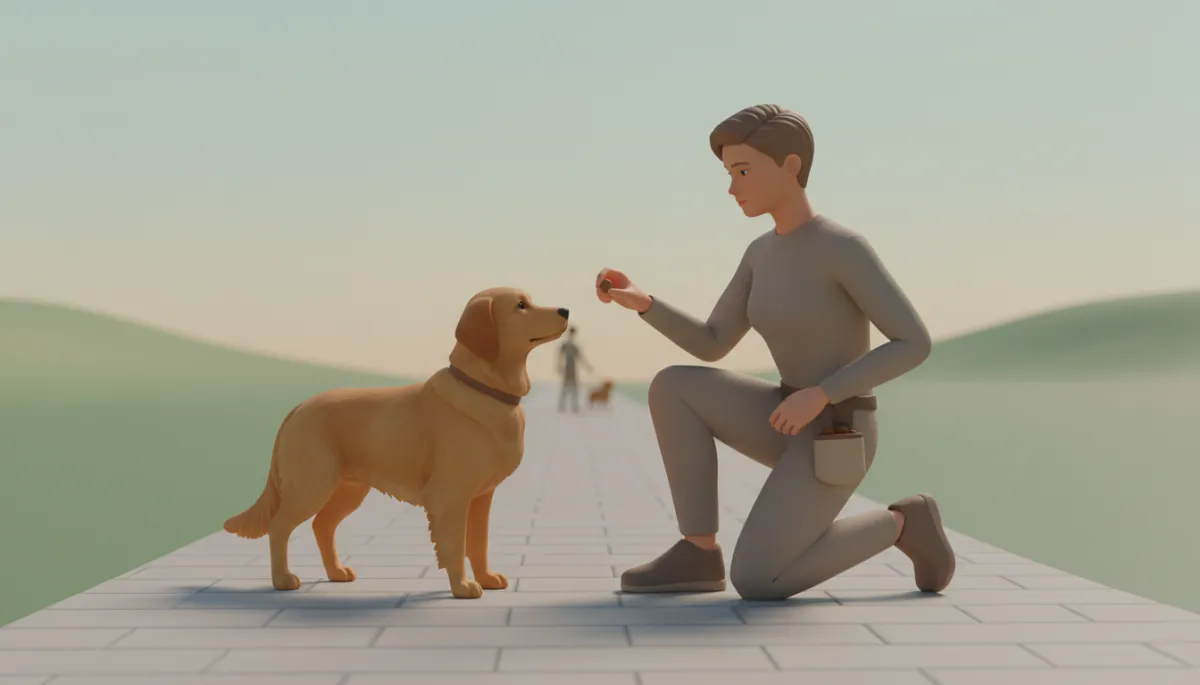
Rewarding calm behavior at safe distances rewires how reactive dogs feel about triggers.
Tip 4: Sleep, Health, and Overall Load
In systems design, we pay attention to overall load and resource usage. Your dog is the same: lack of sleep, pain, or chronic stress massively reduce their ability to cope. A dog recovering from illness or short on rest will be more reactive, just like you’re more irritable when you’re exhausted after an on-call week.
Ensure your dog gets plenty of sleep (many adult dogs need 14–16 hours a day).
Talk to your vet about pain, allergies, or medical issues that could increase irritability.
Balance physical exercise with mental enrichment; both extremes (too little or too much) can worsen reactivity.
7. Practical Reactive Dog Solutions: Designing a Training Plan
Let’s put this together into a simple, engineering-friendly framework you can adapt. Think of it as a high-level design document for your dog’s reactivity work.
Step 1: Define Requirements and Constraints
What situations are hardest for your dog? (Passing dogs, visitors, noises?)
What is your realistic time budget for training per day?
What safety measures do you need in place right now?
Step 2: Implement Management
Immediately reduce the number of intense reactions your dog experiences. That might mean driving to a quiet trail instead of walking a busy sidewalk, or using a “visual firewall” at home. This is your quick patch to stop things from getting worse while you work on the real fix.
Step 3: Train Under Threshold with Systematic Exposure
Create tiny, controlled training sessions where your dog can see a trigger at a comfortable distance and earn rewards for staying composed. Short, frequent sessions (5–10 minutes) are more effective than one long marathon. As your dog’s emotional responses change, you can very gradually decrease distance or increase intensity, always staying below the point where they explode.
Step 4: Review Metrics and Iterate
Just like you’d monitor logs and metrics after a deployment, keep watching your dog’s behavior. Are reactions getting less intense? Is recovery faster? Are you able to work a little closer to triggers? If not, your plan may be moving too fast, or there may be hidden factors (health, environment) to address.
💡 Pro Tip: Success isn’t “my dog never barks again.” Success is “my dog can cope better, more often, with my help.”
8. Pet Owner Advice: Managing Your Own Emotions Too
Living with a reactive dog can be emotionally draining. You might feel embarrassed, judged, or guilty. As someone used to solving problems logically, it’s tempting to blame yourself for not “fixing” it fast enough. But dogs are living beings, not deterministic programs, and progress is rarely linear.
Set realistic expectations: Your goal is improvement, not perfection. Some dogs will always be sensitive, and that’s okay.
Celebrate small wins: A quieter bark, a faster recovery, a successful U-turn—these are all green lights in your behavior logs.
Find your support network: Trainers, behaviorists, and online communities of people with reactive dogs can offer guidance and empathy.
Most importantly, remember that your dog is not giving you a hard time; they are having a hard time. When you shift from “How do I stop this?” to “How do I help you feel safer?” the whole experience changes—for both of you.
9. When to Call in Professionals
As engineers, we know when a bug is beyond our skill set and it’s time to pull in a specialist. The same applies to dog reactivity. Reach out for professional help if:
Your dog has bitten or made serious attempts to bite people or other dogs.
You feel unsafe or overwhelmed handling your dog in public.
Your dog’s behavior is getting worse despite your best efforts.
Look for certified trainers or behavior consultants who use humane, evidence-based methods (reward-based training, desensitization, and counterconditioning). Avoid anyone who frames your dog as “dominant,” “stubborn,” or “naughty” and relies on punishment or intimidation. Those approaches may suppress behavior temporarily but often worsen the underlying emotional responses that drive reactivity.
10. Bringing It All Together: Reactivity as a Long-Term Project
If you think of your dog’s reactivity as a long-running refactor rather than a quick bug fix, the journey becomes more manageable. You’re gradually improving a complex system: understanding behavior, adjusting inputs, and gently rewriting emotional code. There will be regressions and bad days, but over time, with consistent work, the overall trend can be toward calmer, more confident responses.
Along the way, you’ll gain a deeper appreciation for your dog’s inner world. You’ll start seeing their early signals, reading their emotional responses, and proactively supporting them instead of reacting after the fact. That’s the heart of behavior understanding and compassionate pet owner advice: not judging the behavior you see, but honoring the feelings underneath it.
📌 Key Takeaway: Your reactive dog is not broken, and you are not a failure. Together, you’re learning a shared language and building better coping strategies, one small, well-reinforced step at a time.
In the end, understanding dog reactivity is about empathy, patience, and thoughtful design. It’s not about labeling dogs as “naughty” or “good,” but about recognizing that, like us, they are complex systems shaped by genetics, history, and environment. With the right reactive dog solutions, science-backed dog training tips, and a willingness to iterate, you can help your dog feel safer in a noisy world—and that is one of the most rewarding projects you’ll ever ship.
